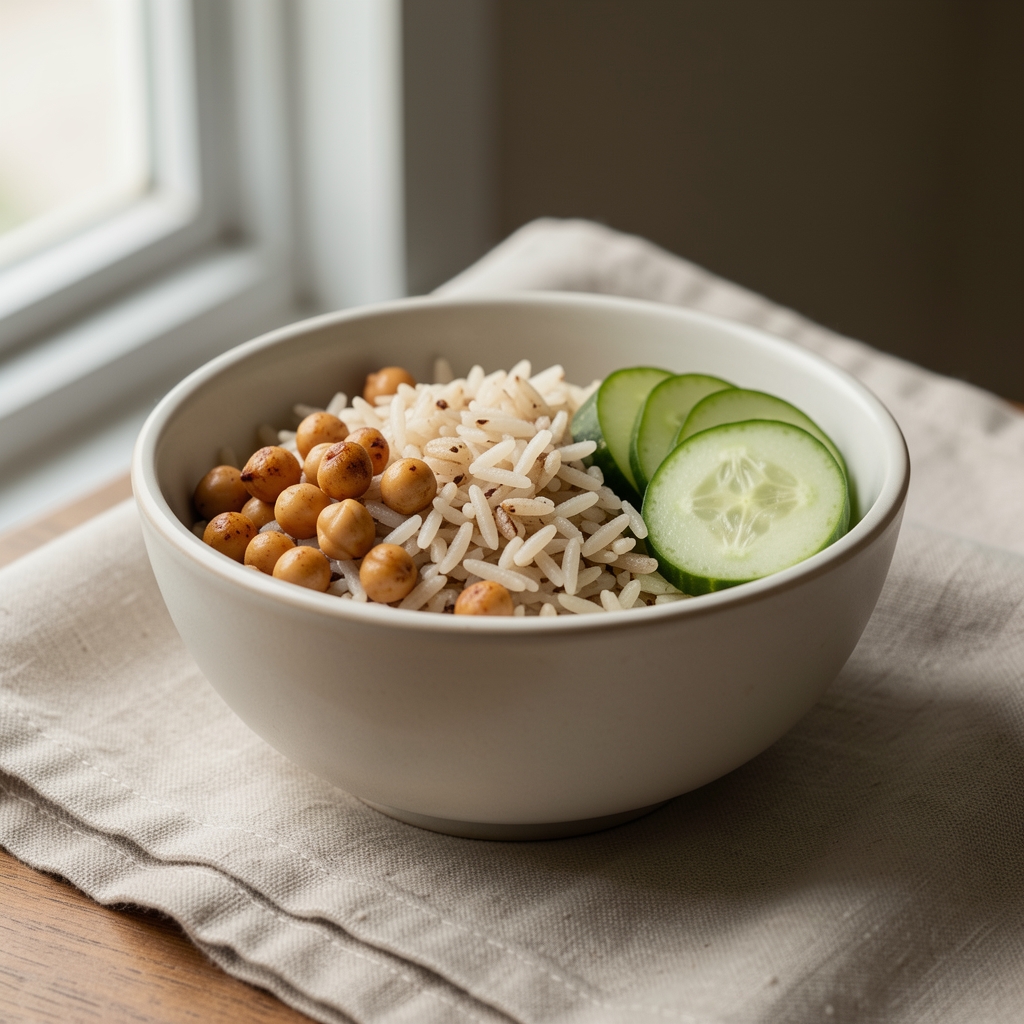
Eating pace is rarely the first variable considered when afternoon focus slips. And yet the rhythms of a rushed midday meal leave an imprint on the hours that follow — one worth tracing carefully. This essay examines what published nutritional observation says about the relationship between how quickly a meal is eaten and what kind of afternoon that meal produces.
The Pace of Eating
The pace at which a meal is consumed occupies a peculiar position in nutritional thinking. It is widely acknowledged — in popular culture, in general dietary guidance, and in the available research literature — that eating more slowly tends to produce better outcomes across a range of measures. And yet the working lunch, in its contemporary form, is almost structurally committed to speed. Fifteen minutes between meetings. A sandwich consumed while reading emails. A bowl of soup finished before a call.
The mechanisms by which eating pace affects post-meal experience are several, and they interact in ways that make the subject more interesting than the simple instruction to "eat slowly" might suggest. Gastric stretch receptors, satiety signals, the speed of carbohydrate breakdown and glucose entry into the bloodstream, the everyday response to the arrival of food in the stomach — all of these are influenced, in different degrees, by the pace at which a meal proceeds.
A meal eaten in ten minutes and a meal of identical composition eaten in thirty minutes will be processed differently by the body — not dramatically differently, and not in ways that every individual notices, but differently in ways that the published evidence documents with consistency. The rapid meal does not allow the body's natural pace of response to register fully before more food arrives. The signals that ordinarily modulate appetite and the experience of fullness — signals that take time to form and to reach their intended destinations — are outrun by the speed of consumption.

The Hurried Lunch
The hurried lunch is a phenomenon of working life that has been documented across a range of occupational contexts. Surveys of eating habits in urban office environments consistently find that a significant proportion of working adults eat their midday meal in under twenty minutes, often at their workstations, and frequently while performing another task. This is not, in itself, a moral failure — it is a response to the genuine structural pressures of contemporary working days. But its effects on the afternoon are worth examining.
The hurried lunch tends to produce two related outcomes that bear on afternoon alertness. The first is a tendency toward overconsumption: when eating pace is rapid, the satiety signals that ordinarily moderate intake arrive after more food has already been consumed than would otherwise have been the case. The meal ends not when the body has registered sufficiency, but when the plate is empty or the available time is exhausted. The result is often a larger meal than was necessary or intended — and meal size, as the first essay in this notebook examined, is itself a significant variable in post-meal alertness.
The second outcome is less well documented but consistently reported in the subjective accounts of people who have experimented with changing their eating pace: a sense that the hurried meal produces a different quality of post-meal experience. Not necessarily a more dramatic energy dip — the research here is mixed — but a different kind of heaviness, a less settled feeling, a difficulty in returning attention fully to whatever follows.
“Eating pace allows the body's natural rhythm to register — a logic that resists reduction to minutes counted at the table.”
What Slowing Down Changes
The published literature on eating rate and its effects on post-meal experience is not entirely straightforward. Some studies find significant differences in glycaemic response between fast and slow eaters consuming identical meals. Others find more modest differences, or differences that depend substantially on the composition of the meal and the individual's baseline metabolic characteristics.
What is reasonably consistent across the literature is the effect of eating rate on the experience of satiety and on subsequent food intake. Slower eating is associated with earlier satiety — the sense of having eaten enough arrives sooner, relative to the amount consumed, when food is eaten more slowly. This has implications both for the total volume of food consumed and for the post-meal energy pattern: a smaller volume of food, consumed more slowly, tends to produce a more measured post-meal experience than a larger volume consumed rapidly.
There is also a less tangible but frequently noted effect: meals eaten slowly, with some degree of attention to the food itself, are associated with greater post-meal satisfaction. This is the observation that underlies a good deal of writing on mindful eating — a concept that, whatever its various applications, rests on a real nutritional phenomenon. The meal attended to tends to leave the eater in a different state from the meal consumed without attention, even when the composition and volume are identical.
Attention and the Meal
-
01
Meals eaten in under fifteen minutes are associated with a higher likelihood of consuming more than satiety required, with consequences for post-meal heaviness.
-
02
Eating slowly allows the body's natural pace to register — satiety signals arrive while food is still being consumed, producing a more accurate sense of sufficiency.
-
03
Meals eaten away from the workstation, with some degree of attention to the food itself, are associated with greater post-meal satisfaction and a more settled return to afternoon work.
-
04
The interaction between eating pace and meal composition is significant — a slowly eaten, compositionally varied meal tends to produce a more attentive afternoon than a rapidly eaten carbohydrate-heavy one.
The connection between attention during the meal and attention after it is one of the more philosophically interesting threads in the nutritional literature on eating pace. There is some evidence that eating while distracted — reading, watching a screen, working — not only increases the volume consumed during that meal but also reduces the sense of satisfaction with it, which then influences snacking behaviour and food choices in the subsequent hours. The meal eaten at a desk while working on something else is not only a hurried meal in terms of pace; it is an inattentive meal in a way that carries its own distinct set of consequences.
This does not require a grand restructuring of the working day. The practical shift — eating away from the workstation when possible, setting aside the phone for the duration of the meal, chewing deliberately rather than reflexively — is modest in structural terms. What makes it significant is the consistency with which it appears in the evidence as associated with a different quality of post-meal experience.
Field Notes, London
In the course of reporting this essay, I spent several weeks tracking my own eating pace across a range of midday settings — a corner desk in a shared office, a canteen queue, a small cafe a short walk from the working space, a kitchen table at home. The differences in eating pace across these settings were substantial, and they seemed to map, with a consistency that I found notable, onto differences in the quality of the afternoon that followed.
The afternoons that followed the cafe lunches — eaten without a phone, without a laptop, with some degree of attention to the food and the room — were, with regularity, different in texture from the afternoons that followed the desk lunches. Not dramatically different. Not so different as to be immediately obvious. But consistently different in the way that the first hour of work resumed: with more accessibility, more readiness, a less effortful return to whatever the afternoon required.
These are field notes. They carry all the limitations of personal observation in an uncontrolled setting. But they are consistent with what the published literature documents, and they feel worth recording as a contribution to this notebook's ongoing examination of the midday meal — not as the record of a universal law, but as the trace of a pattern that the evidence suggests is real, and that the working day rarely gives enough time to consider.
Articles published on Katon Notebook are editorial in nature and reflect the writers' observations on everyday food choices and their relationship to afternoon energy and focus. The content is not intended as professional advice, nor as guidance for the management of any specific condition. Readers with specific concerns about their daily routines are encouraged to speak with a qualified wellness professional.